

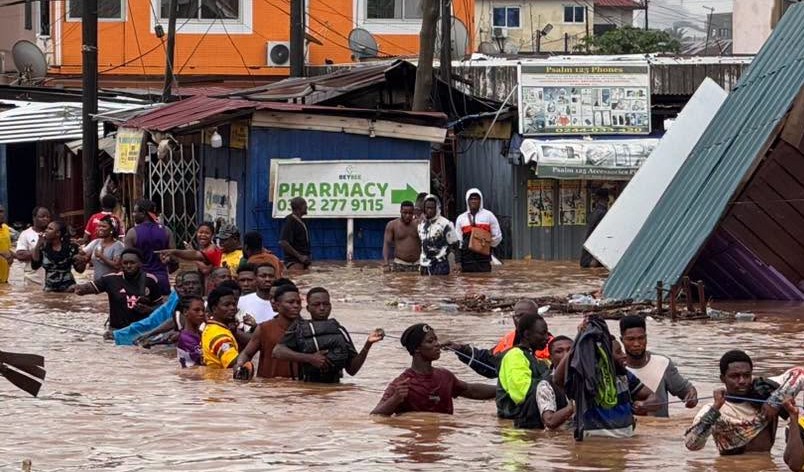
Awula Serwah, Coordinator of Eco-Conscious Citizens, has emphasised that Ghana does not require new legislation to address flooding and environmental degradation. Instead, she argued, the nation’s greatest obstacle lies in the consistent failure to enforce existing laws. Her remarks follow the June 29 downpour, which left many Accra communities struggling with sanitation issues and widespread flooding.
Speaking on Channel One TV’s Breakfast Daily on Monday, July 6, Serwah urged authorities to show the political will to apply the law impartially. “Our laws are sufficient. There is nothing wrong with them. The real problem is enforcement, enforcement, enforcement,” she stressed. As an example of weak enforcement, she alleged that a company had placed shipping containers in a drainage channel despite official orders for their removal.
“Let me give you an example. On Plot 105, Crescent in Cantonment, Brick and Steel Limited has put a double-decker container inside the gutter. This is in the La Dadekotopon Municipal Assembly. They themselves had painted in red ‘Remove by 31st December 2025.’ We are in July 2026. The structure is still in the gutter. The laws are there. You cause it to be removed, and you prosecute the directors of Brick and Steel Limited and get the cost of the removal from them.”
She further criticised the continued development on protected wetlands, saying authorities have repeatedly failed to act against offenders. “The laws are there, but we refuse to apply the laws. People are building on a Ramsar site. All you need to do is to stop them, prosecute them and demolish the structures. We refuse to enforce laws. You cannot make an omelette without breaking eggs. We don’t want to do the needful. We are afraid of votes. I don’t know what we are afraid of, but we need to just do the right thing.”
According to her, Ghana already has sufficient legal provisions and penalties to address environmental violations, but enforcement agencies lack the resolve to implement them consistently. She contrasted the situation in Ghana with the conduct of Ghanaians abroad, arguing that people comply with regulations where authorities consistently enforce the law.
“The same Ghanaians, when they are outside the country, behave properly because there are consequences and you don’t have to go far. Go to neighbouring Rwanda. Do Ghanaians go there and build willy-nilly? Of course not, because they know there will be consequences.”
Source: Juliana Odame Asare

