

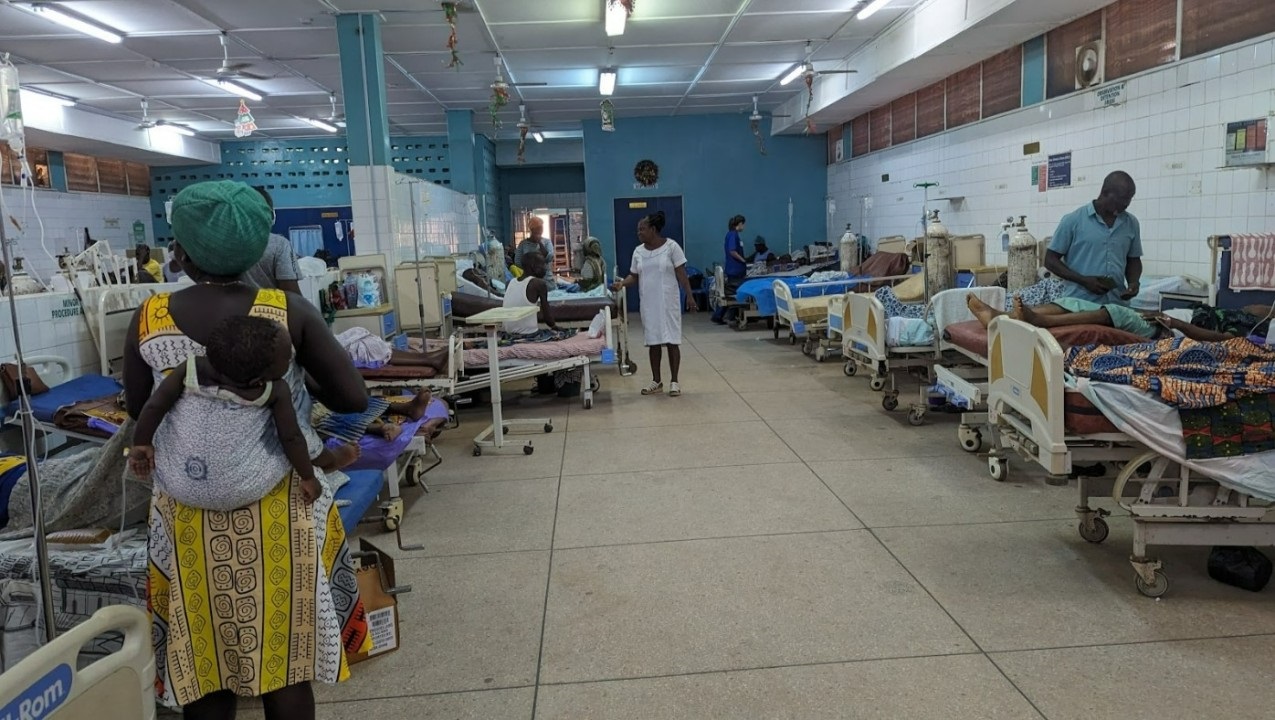
Welcome to Ghana, where healthcare can sometimes feel like a privilege rather than a right. Welcome to Ghana, where emergencies are occasionally treated as inconveniences. To be clear, this does not apply to every health professional—there are many dedicated doctors and nurses who go above and beyond. Yet, troubling experiences are becoming far too common to ignore.
I have personally faced two incidents where hospitals turned me away, asking me to return the next day without even allowing me to explain why I was there. In one case, I took my brother to AIMS Hospital—a facility whose motto boldly proclaims, “Cure for All.” After searching online for nearby hospitals, theirs appeared close by and advertised 24-hour service. It was around 7:00 p.m., and my brother was limping from a swollen leg.
We arrived for the first time and were directed upstairs. After struggling between floors with him in pain, we finally reached a dim reception area. I knocked repeatedly before someone eventually appeared. A gentleman helped call into one of the closed rooms. Eventually, a man opened the door slightly. I greeted him and said we needed help.
His response?
“You didn’t tell her we’ve closed?” that was to the gentleman.
And the door was shut.
No triage nor concern.
I took my brother back downstairs to search for another hospital.
On another occasion in 2025, I visited the Greater Accra Regional Hospital (Ridge Hospital) shortly after 5 p.m. I met a woman in visible pain, nearly in tears. When I approached the nurses and requested to see a doctor, I was told:
“We’ve closed. Come back tomorrow.”
Hospitals close? Is healthcare not structured around shifts? If one shift ends and another begins, do patients simply pause their illnesses?
I left again in search of care elsewhere.
In 2024, I accompanied my mother to the Kasoa Polyclinic for cellulitis treatment. Her hand was swollen from multiple IV insertions. A young nurse came to change the IV. As I watched closely, I saw her consulting YouTube for guidance on what to do next.
Was I alarmed? Absolutely.
She inserted another IV into the same swollen hand. When the doctor arrived and asked who had inserted it, his reaction said everything.
These are not isolated frustrations. They raise larger questions:
Are we adequately training and supervising our health professionals?
Are empathy and patient care still core values?
Are burnout, resource shortages, and system failures pushing workers into indifference?
The recent case of Charles Amissah is heartbreaking. For hours, multiple major facilities; the Police Hospital, the Greater Accra Regional Hospital, and Korle Bu Teaching Hospital reportedly cited “no bed” and referred him onward. While transfers were being arranged, he lay bleeding in an ambulance.
Even if there was no bed, could emergency stabilisation not have been administered?
On February 6, 2026, the 29-year-old engineer lost his life untimely, leaving his family in deep sorry and pain.
This is not merely about individual attitudes. It is an institutional failure. A systemic failure.
Yes, infrastructure is strained. Yes, there may be bed shortages. Yes, health workers are overworked. But in the midst of structural challenges, humanity must not disappear.
Not everyone can afford private hospitals or fly abroad for care.
Public hospitals are not charity centers, they are national institutions funded to serve citizens.
Healthcare is not a favour. It is a right.
But does it seem so when we visit the hospital?
We need to have:
Regular reorientation programmes for health workers
Stronger supervision and accountability systems
Random patient experience audits
Improved staffing and infrastructure
Emotional intelligence and empathy training in medical education
Above all, we must remember: patients are not inconveniences. They are people in vulnerable moments, and the reason one chose to be in the profession.
If we continue to normalise indifference, tragedies will continue quietly away from the media’s eye and headlines.
It is time to do better for the common Ghanaian, the vulnerable, and for all of us.
Source: Hellen Grace Akomah

