

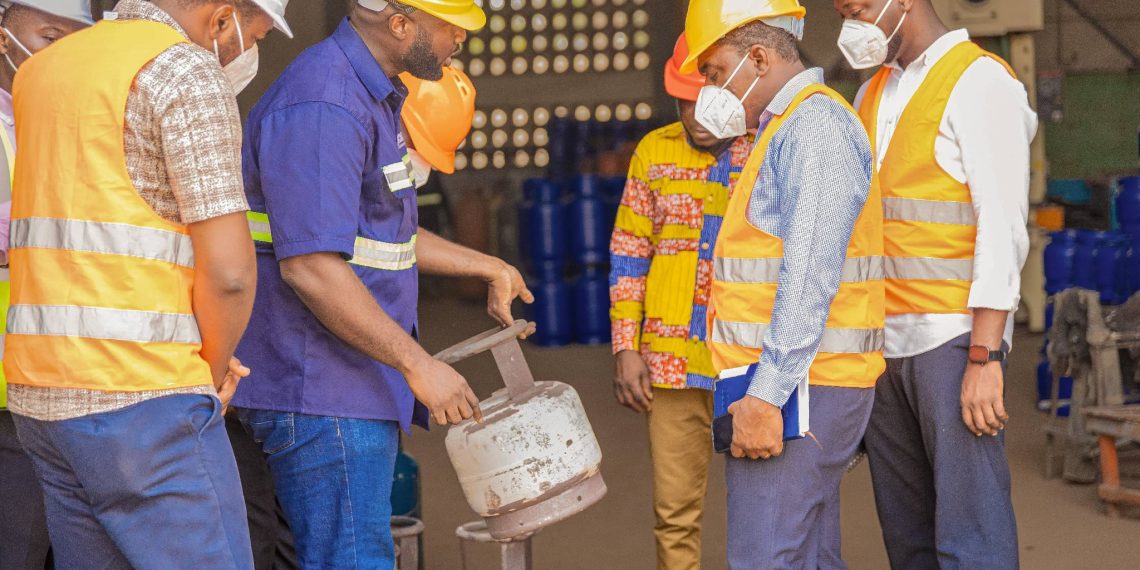
The Ghana Cylinder Manufacturing Company (GCMC) has revealed that a significant percentage of gas cylinders submitted for refurbishment under the Cylinder Recirculation Model (CRM) are no longer safe for use, raising serious concerns about household safety across the country. According to the company, nearly 30 percent of the cylinders inspected for refurbishment were found to be defective and unsuitable for continued use. GCMC management warns that using such faulty cylinders poses a major threat to both lives and property. Defective cylinders increase the risk of gas leaks, fires, and potential explosions, incidents that have historically led to devastating consequences in several communities.
In discussions with journalists, GCMC’s Managing Director, Abdul-Rahman Mankir, emphasised the urgent need to expand the implementation of the CRM beyond its current operational areas. He pointed out that while the model has already been launched in key urban centers like Accra, Kumasi, and Tema, a nationwide expansion would significantly enhance public safety outcomes.
“Currently, it is being run in Accra, Kumasi, and Tema. And so if it is expanded to other regions, I mean it is going to help a lot, especially in terms of keeping our cylinders safe. Very soon, we are going to partner with the NPA to do full-scale public education on the cylinder recirculation model.
“But one thing we have realised is that in some parts, even in Accra, some people don’t even know about the CRM and so when we do the full-scale public education, we are sure people are going to come on board.” The Cylinder Recirculation Model, which is being championed by the National Petroleum Authority (NPA), is designed to ensure that Liquefied Petroleum Gas (LPG) cylinders are regularly inspected, maintained, and replaced when necessary.
Under the model, consumers are expected to exchange empty cylinders for filled and certified ones at designated distribution points, rather than refilling their own cylinders at fuel stations.
Source: Nii Ayikwei Okine

