

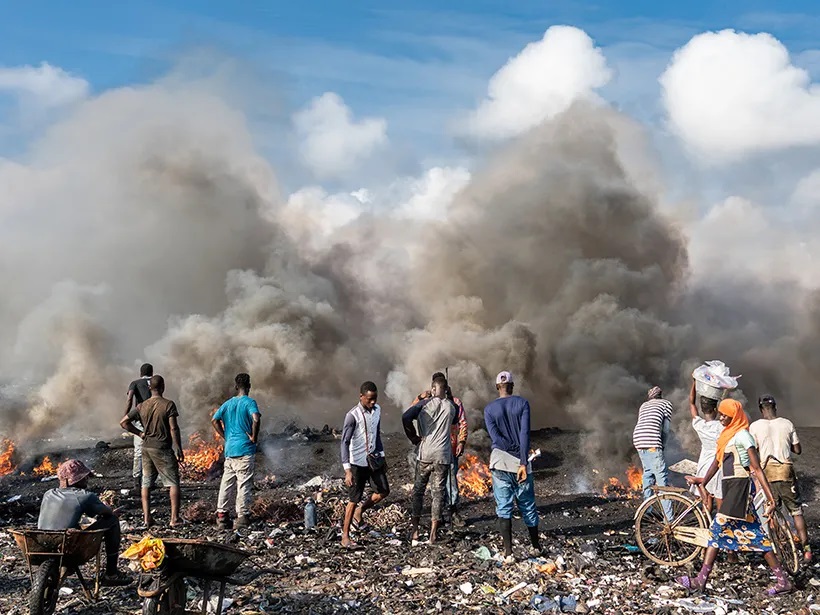
A recent study has revealed that air pollution is now the leading cause of death in the country, surpassing HIV/AIDS, malaria, and road traffic accidents. According to the study, over 30,000 deaths annually in Ghana are attributed to air pollution-related illnesses such as asthma, lung cancer, and cardiovascular disease, a toll that exceeds the deaths caused by malaria and HIV/AIDS.
The sources of pollution include vehicular emissions, open waste burning, the use of firewood, pesticides from agricultural activities, and dust from road construction. The data indicate that air quality levels in many areas significantly exceed the standards set by Ghana’s Environmental Protection Authority (EPA) and the World Health Organization (WHO), highlighting the urgent need to address the poor air quality, especially in the capital region.
This study was conducted by PSS Urbania Consult, a Ghanaian urban planning and environmental consultancy, with technical and financial support from the Clean Air Fund, a global initiative aimed at reducing air pollution worldwide. The one-year research project, which began in August 2024, was extended to September 2025 due to challenges in data collection during the rainy season. It involved continuous monitoring at over 60 sites across the Greater Accra Metropolitan Area.
Hotspots
The identified key pollution hotspots include the following municipalities: Ablekuma Central, Ablekuma North, Ablekuma West, Adentan, Ablekuma South, Ashiedu Keteke, and Okaikoi South. Additional hotspots are found in Ayawaso Central, Ayawaso East, Ayawaso North, Ayawaso West, Korle Klottey, La Dade Kotopon, La Nkwantanang Madina, and Okaikoi North.
In each municipality, four designated monitoring locations were established to collect data on PM2.5, PM10, sulfur dioxide, and nitrogen dioxide over the course of one week.
PM2.5 refers to fine inhalable particles that pose a significant health threat as a major air pollutant. PM10, on the other hand, consists of particulate matter, whether solid or liquid, that is small enough to enter the lungs and can lead to respiratory and cardiovascular health issues.
Event
The findings were unveiled yesterday during a high-level validation workshop for the Air Quality Action Plans developed for 13 metropolitan, municipal and district assemblies (MMDAs) within the Greater Accra Region. The findings were presented by Lead Consultant at PSS Urbania, Dr Joseph Ayitio, and Air Quality Specialist of PSS Urbania, Frederick Otu-Larbi.
The workshop marks a critical step towards evidence-based environmental governance and public health protection. It featured presentations, discussions and working group sessions aimed at education, sensitisation and strategic planning. It brought together key stakeholders from the Ministry of Local Government, Chieftaincy and Religious Affairs, the Greater Accra Regional Coordinating Council, the National Development Planning Commission and the Ghana Institute of Planners, among others.
Priority
Director of Policy Planning, Monitoring and Evaluation at the Ministry of Local Government, Usama Iddrisu Samu, emphasised the urgency of addressing air pollution as a national development priority. Highlighting the recent passage of Ghana’s new Air Quality Management Regulation and the alignment with ongoing district-level planning, he said air pollution caused over 28,000 deaths annually in Ghana, more than malaria and HIV combined.
Mr Samu praised the Clean Air Fund and partners for supporting evidence-based planning, including air quality monitoring and hotspot identification, and called for swift and committed action to translate the Air Quality Action Plans into real environmental and public health improvements.
“Our local government authorities are preparing their middle and long-term plans. This must remind us that cleaner air is not just an environmental aspiration, but a development priority that must be at the heart of our national agenda,” he said.
“This initiative is not only timely, but essential, as it represents a decisive step towards safeguarding the environment and protecting the health of our citizens,” he said.
The Director of Planning of the Greater Accra Regional Coordinating Council, Jemima Lomotey, who spoke on behalf of the Regional Minister, Linda Obenewaa-Akweley Ocloo, emphasised the region’s commitment to turn air quality action plans into concrete improvements.
She highlighted the urgent need to tackle air pollution in the Greater Accra Region, Ghana’s most urbanised and industrialised region.
Local ownership
A representative of Clean Air Fund, Dr Elvis Kyere Gyeabuor, praised the integration of air quality discussions into regular district activities. While acknowledging the grant’s life cycle, he emphasised that the current validation workshop should mark the beginning of local ownership and long-term action, and not the end of the process.
The Principal Planning Analyst at the National Development Planning Commission (NDPC), Dr Lily Owusu, emphasised the urgent need to integrate air quality action plans (AQAPs) into the medium-term development plans of 13 selected MMDAs. She highlighted the worsening air quality in Accra due to urbanisation, industrialisation and poor waste management, with significant health impacts on vulnerable groups.
Dr Owusu commended the government’s target to meet WHO air quality standards by 2040, and stressed that clean air was not just an environmental goal, but a development priority.
Air pollution action
The Municipal Chief Executive for Ayawaso West, Dr Michael Mensah, emphasised the need to address air pollution, citing its growing health impact amid urbanisation and rising emissions. Dr Mensah highlighted the alignment with global Sustainable Development Goals and called for collaborative, innovative efforts to build cleaner, healthier, and more resilient urban environments.
Source: Beatrice Laryea

