

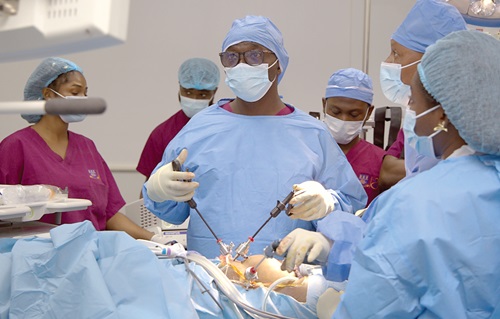
The University of Ghana Medical Centre (UGMC) has made a significant advancement in weight loss surgery in Ghana by performing the country’s first-ever pin-hole surgery on an obese patient. The laparoscopic gastric sleeve surgery, a type of bariatric surgery, involves removing a large portion of the stomach to create a smaller, sleeve-shaped stomach. This procedure was carried out on a patient at the facility on Friday, July 25, 2025.
The historic surgery lasted approximately three hours and was conducted by a 30-member medical team, which included surgeons, anesthetists, perioperative and recovery nurses, nutritionists, and other supporting medical staff. The team was led by Dr. Kenedy Ondede, the Head of the Surgery Department at Kenyatta National Hospital in Nairobi, Kenya. During the surgery, about 80 per cent of the patient’s stomach was removed, significantly restricting the amount of food that can be consumed, ultimately aiming for weight loss. Key members of the surgical team also included Dr. Dominic Darkwa, a General Surgeon Consultant at UGMC, and Dr. Emmanuel Nachelleh, the Head of the Surgery Department at UGMC.
The surgical process
Dr Ondede explained to Graphic Online’s Timothy Ngnenbe that the laparoscopic gastric sleeve surgery was done through a small opening, referred to as a pinhole, of not more than one centimetre. “We have five of these small holes; one takes the camera; we turn inside to be outside so that we see everything like what we do in open surgery. Through these openings, we are able to maneuver to release the stomach from its attachment – that is where food is stored and allow patents to put on a lot of weight.
“We release the stomach from its attachment, and we are able to split it. About 60 to 80 per cent of the stomach is removed, and that narrows the tube and also means that the patient is able to eat little,” he explained. Dr Ondede explained that the fat in the body of the patient would be used as long as they did not eat more, “and in no time, you will lose all the fat in your body.”
Minimal side effects
Discussing the potential effects of laparoscopic gastric sleeve surgery, Dr. Ondede stated, “The primary effect we aim to achieve is weight loss, which is a positive outcome.” He emphasized that reducing the stomach’s capacity to accommodate more food is not detrimental to patients. “We ensure that the rest of the diet is balanced and provide supplements when necessary, allowing patients to live a normal life,” he explained.
Dr. Ondede noted that the advantages of this surgery far outweigh its disadvantages, which primarily involve weight loss. “If you are obese, you are likely to face heart issues, problems with blood sugar control, joint pain, breathing difficulties, and more. By losing weight, patients have a better chance of avoiding these complications and can experience a renewed life,” he concluded.
Historic feat
Dr Darkwa said the success of the surgery was good for the UGMC’s quest to advance medical interventions to the general public. He said it was refreshing that UGMC continue to blaze the trail in modern medical and clinical interventions in the country. “For UGMC, this is the first time the surgery has been done, and I am not aware that it has been done in any facility in the country,” he added. He said UGMC was inspired to do that surgery because of the increasing cases of non-communicable diseases, including obesity. He said in Ghana, about 17 to 25 per cent of the population was obsessed, which was why the new dawn was critical.
Caution
He cautioned members of the public to watch their diets and avoid sedentary lifestyle to prevent getting overweight or obese.
“The first thing is reducing your caloric intake to make sure that you do not get obese. Cut down the in-between meals, sugary and fatty foods; but if you happen to be obese and you cannot use the conventional way to reduce it, you can come, we will assess you and see whether the surgery is the best way out for you.
Context
According to the World Health Organisation (WHO) overweight and obesity are defined as abnormal or excessive fat accumulation that presents a risk to health. A body mass index (BMI) over 25 is considered overweight, and over 30 is obese. In 2019, an estimated 5 million noncommunicable disease (NCD) deaths were caused by higher-than-optimal BMI.
The global health body adds that from 1990 to 2022, the percentage of children and adolescents aged five to 19 years living with obesity increased four-fold from two per cent to eight per cent globally while the percentage of adults 18 years of age and older living with obesity more than doubled from seven per cent to to 16 per cent.
By: Timothy Ngnenbe

