

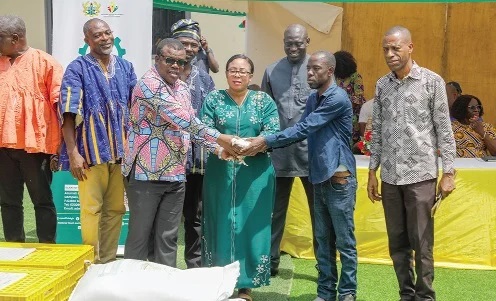
The government has set a target to distribute seven million birds this year under the Nkoko Nkitinkinti initiative, part of efforts to boost poultry production and reduce reliance on imported meat. The programme forms a key component of the poultry revitalisation drive within the flagship Feed Ghana Programme (FGP).
Speaking at the launch of the distribution in Accra last Friday (February 13), Bright Kwadzo Demordzi, National Coordinator of the FGP, explained that the plan is to recruit and train poultry farmers nationwide before rolling out the birds. “Our goal is to produce seven million birds this year. We are engaging families as well as commercial farmers across large, medium, and small-scale operations. Once training and capacity-building are complete, we will distribute the birds across the country,” he said.
Nationwide rollout
The event, held at the residence of the Greater Accra Regional Minister in Accra, brought together metropolitan, municipal, and district assemblies (MMDAs), along with several municipal chief executives from the region. Mr. Demordzi explained that the programme is being implemented nationwide, noting that regions such as Ashanti, Bono East, Ahafo, and Bono have already benefited from the distribution.
Following the rollout in Accra, he said the team would move on to the Eastern Region, then to Western North, Central, and Western regions, before continuing to Volta and Oti. The plan, he added, is to ensure that by April this year, all regions will have accessed the programme and beneficiaries enrolled for a second phase. “This is not a short-term initiative. It is designed to make Ghana self-sufficient in meat production,” he emphasized
Production targets
Mr Demordzi said the country produced only about five per cent of its meat requirements, a situation he described as unsatisfactory. He said the long-term goal was to raise local meat production to between 70 and 80 per cent by 2028 to reduce imports. He explained that distribution had been decentralised and placed in the hands of district chief executives, district directors of agriculture and the animal production units of the Ministry of Food and Agriculture.
Value chain approach
Mr Demordzi also said the initiative went beyond the distribution of birds and targeted the entire poultry value chain. “We are not only distributing birds. We are putting up processing facilities across the country,” he said. He cited the commencement of a processing factory project at Bechem and another at Pru as examples of efforts to ensure sustainability in the sector. “If you are able to work on the whole value chain, then sustainability is assured,” he added.
Benefits
The Greater Accra Regional Minister, Linda Ocloo, said the initiative formed part of the government’s efforts to restore the country’s capacity to produce, process and consume what it grows. She said the project would support households to produce eggs and poultry for local markets under a strategy that targeted small, medium and large-scale producers. The minister urged metropolitan, municipal and district chief executives (MMDCEs) to ensure transparency and fairness in the distribution of inputs and to encourage beneficiaries to adhere to technical guidelines. She commended the Ministry of Food and Agriculture and the Feed Ghana Programme team for translating policy into practical support for citizens and declared the regional rollout duly launched.
Streetlights
At the same event, the Regional Minister distributed streetlights to MMDAs in the region as part of continuous efforts to improve public safety. Each assembly received 100 streetlights. Mrs Ocloo urged MMDCEs to move swiftly to install the streetlights in strategic locations, particularly markets, lorry stations, major intersections and other public spaces.

Source: Joselyn Kafui Nyadzi

