

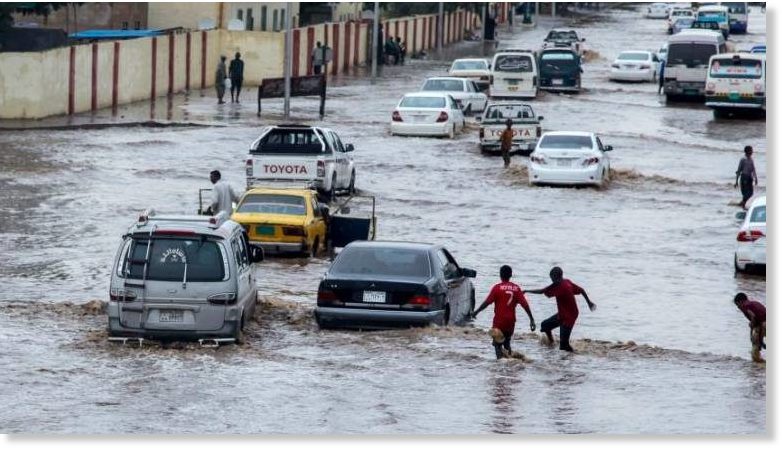
The Pro-Vice-Chancellor of the University of Ghana, Professor Samuel Nii Ardey Codjoe, has emphasised the need for a comprehensive risk management strategy to address Ghana’s ongoing flooding challenges. As a geographer and soil scientist, he highlighted that this strategy should include aspects such as safety awareness, evacuation plans, and support for the psychological needs of those affected.
Professor Codjoe, who oversees the university’s research, innovation, and development, pointed out that the current structure of institutions involved in flood management—from national to district levels—is overly complex and requires better integration to operate effectively.
He delivered his inaugural lecture as a full professor last Thursday, focusing on the topic: “Reading the Skies and Healing the Land: Climate, Indigenous Knowledge, and Health.” The lecture was well-attended, attracting former Vice-Chancellors, politicians, members of the university community, students, and friends of the professor.
Prof. Codjoe said the prediction that Africa was likely to experience more flooding in the coming years called for Ghana’s institutions to work closely with local authorities in a coordinated fashion to deal with the situation head-on.
He said currently, the National Disaster Management Organisation (NADMO) appeared to have been overwhelmed by the situation and that called for a new approach in tackling it. The Population Studies professor added that the causes of the yearly flooding were many and complex, including residents building in environmentally sensitive areas and dumping of refuse in gutters.
The lecturer established that climate change was a major environmental and health challenge affecting livelihoods, food security and well-being. The lecture examined links between climate change, indigenous knowledge, disease patterns and health care in Ghana.
The lecturer argued that effective adaptation required integrating scientific evidence with local knowledge to strengthen climate monitoring, disease prevention and a resilient health system. “Knowledge does not reside in laboratories and universities alone. It’s not the prerogative of education holders,” Prof. Codjoe postulated.
He posited that long before science, traditional people were able to read the weather and could tell the future through nature, including the use of avian species – birds. That, according to him, called for collaboration between science and traditional rulers to find a permanent solution to the challenge.
Dealing more with the effect of climate change, a major contributor to flooding, the scholar said the shift from the use of terracotta or ceramic roofing to colour-coated aluzinc was a cause of the increasing heat in rooms and indoors. Prof. Codjoe questioned the continued use of red roofing sheets instead of white or light-coloured roofs, which did not attract heat.
The professor said a lot of Ghanaian rooms were sealed with no air-conditioning and proper ventilation avenues, contributing to intense heat in rooms. He advised the planting of more trees and greens in homes to reduce the “baking heat” and provide shelter to ease the heat condition in homes.
Source: Daniel Kenu

