

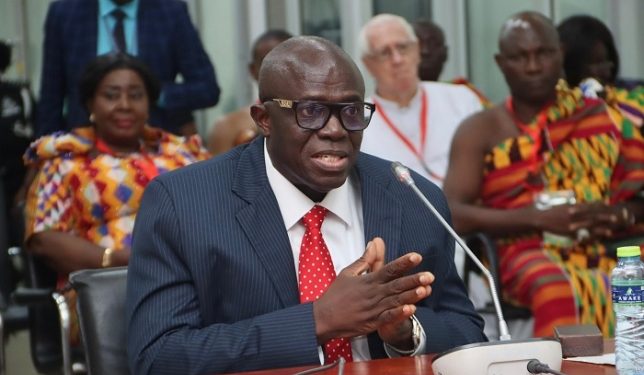
Justice Senyo Dzamefe, a nominee for the Supreme Court bench, told Parliament’s Appointments Committee that practical wisdom is more important than legal theory in delivering justice to ordinary Ghanaians. During his appearance before the Committee on Monday, June 16, 2025, Justice Dzamefe, who currently serves on the Court of Appeal, stated, “Law is 20% technical knowledge and 80% wisdom.” He emphasized that the ability to exercise good judgment is crucial for achieving fair outcomes, particularly in a country where many individuals interact with the legal system without legal representation.
During his vetting, Justice Dzamefe proposed several measures to reduce delays in the court system. In response to a question, he suggested that more courts should be established to distribute the workload effectively. Additionally, he recommended using artificial intelligence to produce transcripts instantly and proposed virtual court sessions to lower travel costs for litigants. “By the end of a court sitting, records should be ready,” he said.
Justice Dzamefe also proposed a three-month limit for the completion of criminal trials and a six-month limit for civil cases. When discussing property-related issues, he explained that the courts are guided by principles of fairness and the law. In response to MP Alhassan Sayibu Suhuyini, he noted that jointly acquired property in divorce cases should be shared equitably. Inheritance cases are governed by PNDC Law 111 or valid wills, and the courts intervene when necessary to protect the interests of surviving spouses. He cited the case of Agyei v. Nartey as an example.
“The court intervenes to ensure reasonable provision.” Justice Dzamefe also expressed support for public tribunals. Answering a question from MP Patrick Yaw Boamah, he said such tribunals help make justice more accessible and that laypersons offer important perspectives in legal decision-making. “Laypeople bring wisdom to cases and cannot be bullied,” he said.
He further raised concerns about the judiciary’s financial dependence. Responding to MP Hassan Tampuli, Justice Dzamefe noted that while the judiciary operates independently in legal and administrative terms, it remains reliant on Parliament for its funding.
“Judicially and administratively, we are independent. Financially, I don’t think we are, because Parliament allocates our budget,” he said. He argued that financial autonomy would allow the judiciary to function more efficiently. Justice Dzamefe has served as a High Court judge in Sekondi, Swedru, and Accra, and is a former President of the Association of Magistrates and Judges.
By: Mohammed Ali

