

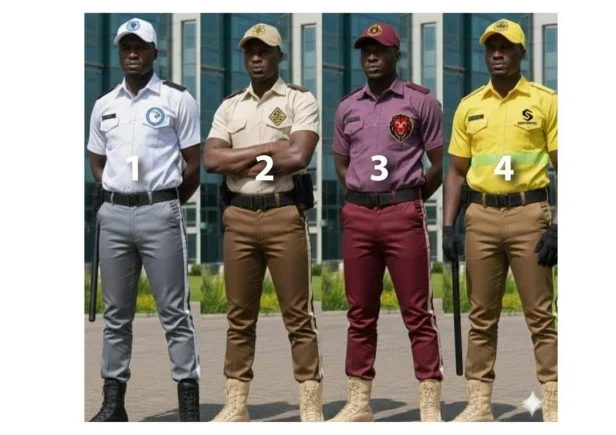
To prevent impersonation and ensure clear public identification, the Ghana Police Service has introduced a strict national uniform code that prohibits private security personnel from wearing attire resembling that of state security agencies. In a Public Notice issued by the Director-General of Private Security Organizations, four approved uniform combinations have been outlined as mandatory for all private security operators and their staff nationwide.
The directive, issued under Regulation 12 of the Police Service (Private Security Organisations) Regulations, 1992 (LI 1571), specifies the following permitted uniforms:
A specialised uniform—yellow shirt with ash/grey reflectors across the front and back, worn with brown khaki trousers—is reserved exclusively for personnel in the mining and oil sectors.
White long- or short-sleeve shirt paired with ash khaki trousers featuring white side stripes.
Cream long- or short-sleeve shirt paired with brown khaki trousers with cream side stripes.
Mauve long- or short-sleeve shirt paired with maroon trousers with mauve side stripes.
The directive draws a firm line against improvisation, stating unequivocally that “any other uniform, colour combination, design, or turnout not listed above and that has a resemblance to the uniforms of any state security agency is deemed unauthorised.”
The directive is intended to eliminate public confusion and ensure private security personnel are not mistaken for police or military officers—a concern that has persisted across various sectors. It establishes a dual compliance requirement: all private security operators must adhere strictly to the approved uniform specifications, and in-house security teams are equally prohibited from wearing attire resembling that of state security agencies.
The regulator cautioned that violators will face sanctions as provided by law, though specific penalties were not outlined. In addition, the notice calls for public vigilance, urging citizens to familiarise themselves with the approved uniforms and report any suspected breaches to the appropriate authorities.
Source: GraphicOnline

