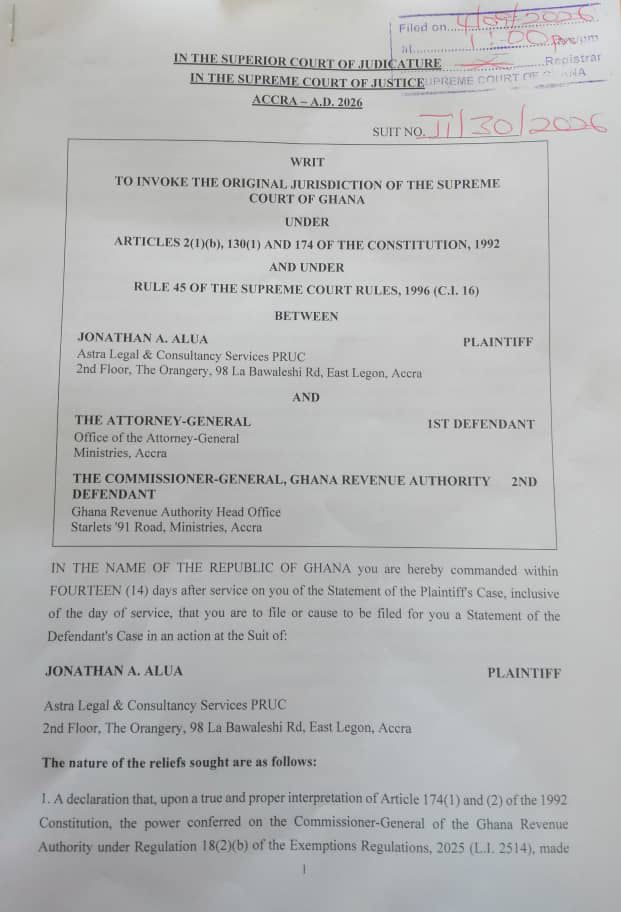
Legal practitioner Jonathan A. Alua has filed a suit at the Supreme Court against the Attorney‑General and the Commissioner‑General of the Ghana Revenue Authority (GRA), contesting the authority’s power to determine passenger baggage exemptions from customs duties and taxes.
The action, brought under the Court’s original jurisdiction, challenges Regulation 18(2)(b) of the Exemptions Regulations, 2025 (L.I. 2514). Mr. Alua argues that the provision is unconstitutional because it empowers the GRA Commissioner‑General to waive or vary taxes without prior parliamentary approval.
Citing Article 174(2) of the 1992 Constitution, the plaintiff contends that any waiver or variation of tax in favour of individuals or institutions must first be sanctioned by a resolution of Parliament. He maintains that granting the Commissioner‑General authority to determine the quantity of passenger baggage exempt from customs duties amounts to exercising that constitutional power unlawfully.
Accordingly, Mr. Alua is asking the Supreme Court to declare Regulation 18(2)(b) inconsistent with the Constitution to the extent that it allows the Commissioner‑General or Customs officers to grant or refuse baggage exemptions on a case‑by‑case basis without parliamentary approval.
He is also seeking an order restraining the GRA from exercising the disputed power until the requirements of Article 174(2) have been complied with, or Parliament has passed a resolution under Article 174(3) exempting the exercise of the power from that requirement.
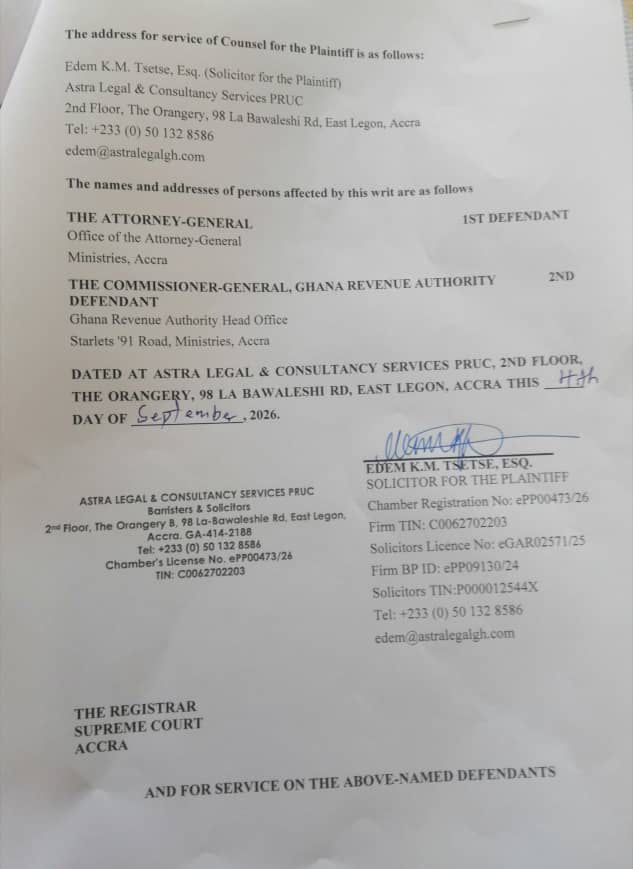
Mr Alua further wants the Supreme Court to issue any additional orders it considers necessary to give effect to the declarations being sought. The plaintiff is also seeking costs. Meanwhile, the Attorney-General and the GRA are required to file their respective statements of case within 14 days after being served with the plaintiff’s statement of case.