

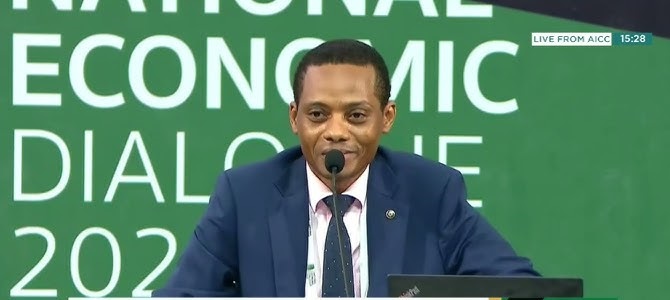
A team of economists has proposed a series of measures to stabilize Ghana’s economy, identifying weak revenue generation, poor public expenditure management, and excessive borrowing as the primary causes of the country’s ongoing economic challenges. During the presentation of the interim report by the Macroeconomic Stability Group at the National Economic Dialogue (NED) 2025 on Tuesday, March 4, at the Accra International Conference Centre, economist Leslie Bright Mensah outlined several recommendations aimed at addressing these long-standing issues. These recommendations include promoting fiscal discipline, implementing tax reforms, ensuring exchange rate stability, and enhancing public sector efficiency to prevent future economic crises.
Macroeconomic challenges and the need for urgent action
Mr. Mensah emphasized that while macroeconomic stability is crucial for Ghana’s development, maintaining it has proven to be a challenge. He attributed the country’s recent economic crisis to unsustainable fiscal policies, particularly excessive budget deficits and rising debt service costs. “In the five years leading up to the 2022 economic crisis, Ghana’s budget deficit averaged 9 percent of GDP, and in 2021, debt servicing accounted for nearly 70 percent of public revenue. This has contributed to the fiscal difficulties we are still facing today,” he stated.
He also pointed to Ghana’s prolonged high inflation, which has remained above 20 per cent for 34 consecutive months, compared to just six months in the 18 years before the crisis. The depreciation of the cedi, which lost 19.2 per cent of its value in 2024 alone, was another major concern.
Fiscal discipline and tax reforms
To strengthen the economy, the group proposed simplifying the tax system and maintaining consistency in tax policies. “The government must adopt a medium-term approach to tax policies to give businesses certainty and encourage compliance,” Mr Mensah stated. He also called for a review of the VAT system to reduce the more than 50 per cent VAT compliance gap, suggesting that lowering VAT rates could improve collection.
In addition, the group urged authorities to reform property tax administration by using technology to boost compliance and revenue. “One major concern is property tax. The Accra Metropolitan Assembly, one of Ghana’s wealthiest local government bodies, has a property tax under-collection rate of over 60 per cent. This must be addressed,” he noted.
Public financial management and government spending
Mr Mensah stressed the need for strict enforcement of financial laws, particularly the Public Financial Management (PFM) Act, which requires the government to report regularly on expenditures and liabilities. “Many of these reporting requirements have not been followed. If the Finance Minister ensures compliance with the PFM Act, it will help strengthen fiscal discipline,” he stated. The group also recommended reviewing the Fiscal Responsibility Act to curb excessive government spending and improve parliamentary oversight.
Exchange rate stability and monetary policy
On stabilising the cedi, Mr Mensah called for stronger regulation of foreign exchange bureaus, the elimination of illegal forex markets, and better coordination between the Ministry of Finance and the Bank of Ghana. He also urged the central bank to integrate fintech liquidity into the formal banking system to improve financial stability. Additionally, he suggested reviewing foreign exchange retention policies in key industries such as mining to ease pressure on the local currency.
Banking sector and financial stability
The group recommended recapitalising the Bank of Ghana to strengthen its ability to manage monetary policy effectively. They also called for a feasibility study on non-interest banking, arguing that this could provide alternative financing options and expand financial inclusion.
The way forward
Mr Mensah stated that implementing these measures would help restore investor confidence, stabilise the exchange rate, and create a more predictable business environment. The National Economic Dialogue 2025 brought together economic experts, policymakers, and government officials to discuss ways to strengthen Ghana’s economy and prevent future crises.
By: Mohammed Ali

