

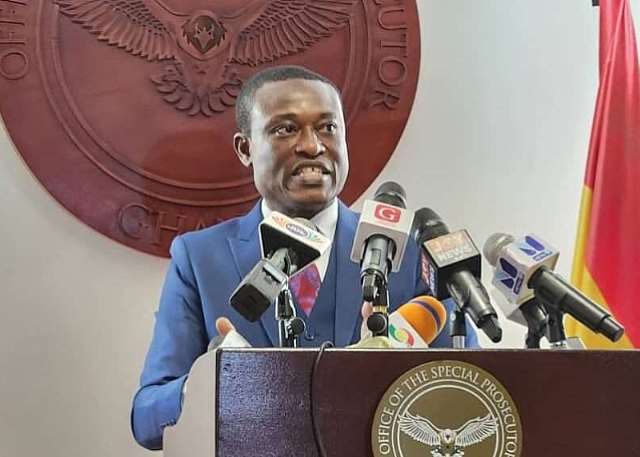
The Attorney-General (A-G) has expressed support for a lawsuit at the Supreme Court that challenges the constitutionality of the Office of the Special Prosecutor’s (OSP’s) authority to conduct prosecutions. Although the A-G is the defendant in this case, a draft statement of the case attached to a motion for an extension of time indicates that he will ask the Supreme Court to declare the OSP’s prosecutorial powers unconstitutional.
The motion for an extension of time was filed by the A-G at the Supreme Court on April 8, 2026. This extension is intended to allow him to submit his statement of case outside the usual timeframe in order to respond to the lawsuit initiated by private legal practitioner Noah Ephraem Tetteh Adamtey in 2025.
In his draft statement of case, the A-Gs argues that Article 88 (3) of the 1992 Constitution solely vests prosecutorial powers in the A-G alone, and therefore Parliament acted unconstitutionally by passing the OSP Act, 2017 (Act 959), which made it compulsory for the A-G to delegate part of its prosecutorial powers to the OSP.
Article 88 (3) of the 1992 Constitution stipulates that “The Attorney-General shall be responsible for the initiation and conduct of all prosecutions of criminal cases”, while Article 88 (4) provides that: “All offences prosecuted in the name of the Republic of Ghana shall be at the suit of the Attorney-General or any person authorised by him in accordance with law”. Again, the A-G contends that Act 959 has unconstitutionally varied the prosecutorial powers of the OSP in many ways.
“First, it compels the Attorney-General to abandon its constitutional duty to be responsible for the prosecution of all criminal offences—he is, by the terms of the Act, now only responsible for the prosecution of offences which the OSP is not prosecuting. This effectively converts what was intended by the framers to be a delegation into a donation,” the A-G stated. ““Secondly, the donation of the powers to the OSP also divests the Attorney-General of his control over the Office’s use of the power. The essential tools for control of prosecution are plea bargain and the entry of nolle prosequi. These tools are exclusively for the Attorney-General and are used by him to control prosecution,” the A-G added.
The principal legal advisor to the government further contends that Act 959, which establishes the OSP, violates the 1992 Constitution, specifically Article 88.
“Parliament has enacted the Act, an ordinary legislation. It has purported, without amending the Constitution, to vary significant constitutional power in a way that purports to divest some essential components of the prosecutorial power. We submit that, by this conduct, Parliament has, without doubt, acted in excess of the power conferred on it by the Constitution,” the A-G stated.
On December 12, 2025, Mr Adamtey invoked the exclusive original jurisdiction of the Supreme Court to interpret the constitution by filing a suit for the court to declare the exercise of prosecutorial powers by the OSP as unconstitutional.
He is seeking, among other reliefs, a declaration that the OSP Act, 2017 (Act 959) is unconstitutional to the extent that it confers “original or insulated prosecutorial authority on the Office of the Special Prosecutor, is inconsistent and in contravention of Articles 1(2), 88(3), (4), 93 (2) and 296 of the Constitution and is, therefore, null, void and of no effect”.
Again, he is seeking a declaration that “sections 3(3) and 4 of Act 959, in purporting to make the Office of the Special Prosecutor independent of the Attorney-General in the initiation, conduct and termination of prosecutions, violate the Constitution.”
Source: Emmanuel Ebo Hawkson

