

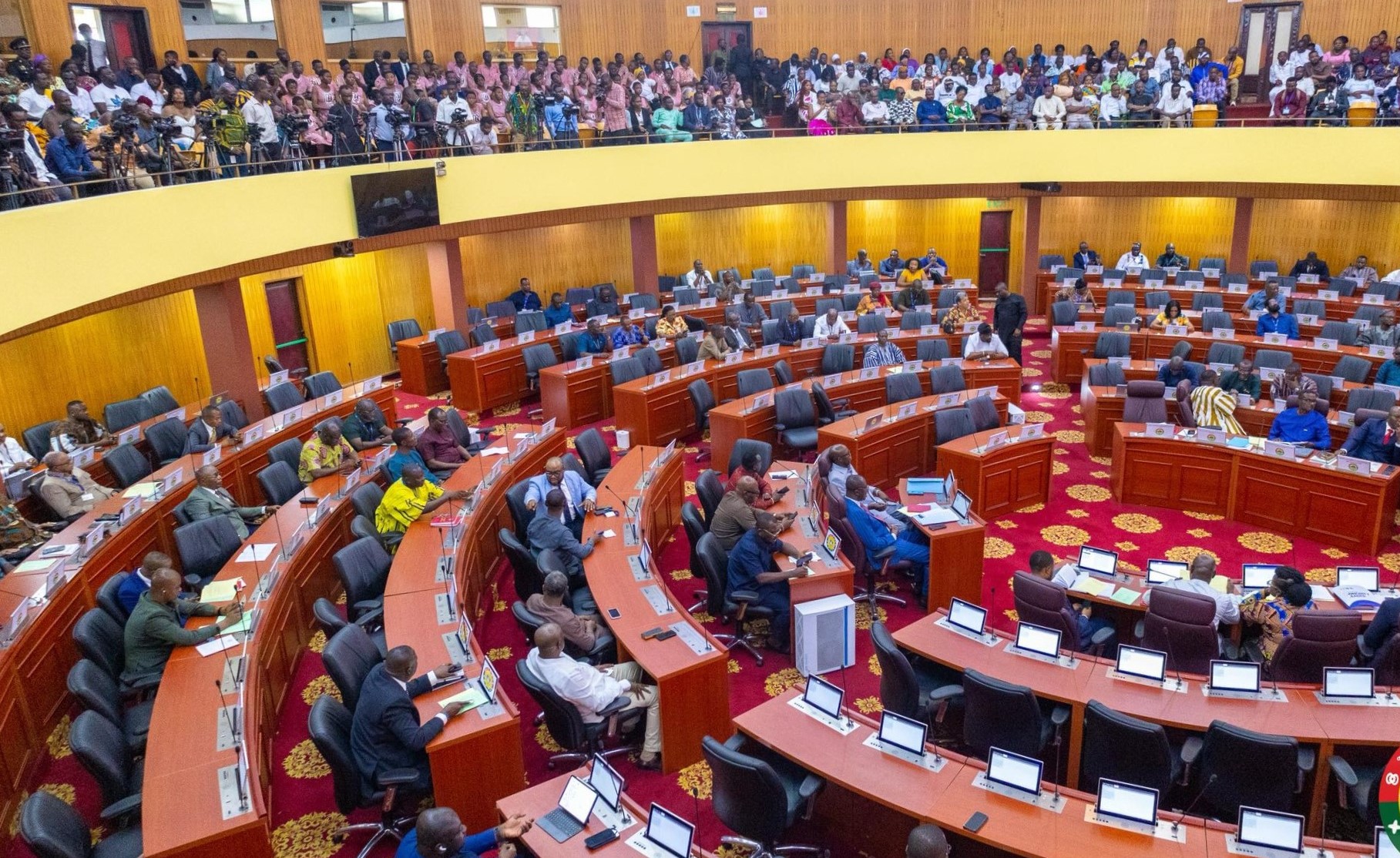
Despite opposition from the Trades Union Congress (TUC) and a boycott by the Minority, Parliament has passed the Public Tribunal Bill, 2026, establishing a legal framework for the operation of tribunals in Ghana. The Bill seeks to provide for the creation, jurisdiction, composition, and functioning of tribunals in line with the Constitution, while also setting up a Tribunal Oversight Committee.
Its objectives include enhancing access to justice, safeguarding citizens’ rights, promoting due process, and improving the efficient administration of justice, particularly in cases requiring specialised or expedited resolution.
The Bill was introduced to the House on June 26, 2026, by the Minister of Lands and Natural Resources, Emmanuel Armah-Kofi Buah, on behalf of the Attorney-General and Minister of Justice, Dr. Dominic Ayine, and was subsequently referred to the Constitutional and Legal Affairs Committee.
Rationale for the Bill
Dr Ayine explained that the establishment of the tribunals had become necessary in order to address the backlog of cases in the traditional courts and to promote access to justice. He indicated that the backlog of cases in the traditional courts continued to increase by approximately 3,360 cases annually, resulting in delays and prolonged adjudication. “The establishment of the tribunals would help reduce this burden and ensure the expeditious disposal of cases,” he said.
The minister indicated that Article 142 of the Constitution integrates Regional Tribunals into the judicial structure. However, Regional Tribunals had become defunct in practice, and the Bill therefore sought to address that lacuna in the legal framework governing tribunals.
FOR ENQUIRIES: 0501260139/02043552202
Minority’s boycott
However, prior to the passage of the bill after a long and heated debate, the Minority Leader, Alexander Afenyo-Markin, argued that the entire Clause 4 be deleted since it created confusion in the country’s judicial system. However, the Majority Leader, Mahama Ayariga, opposed the application, saying that the bill would be passed regardless of how long the House sat to consider the clauses.
After the debates over Clause 4 came to an end, the First Deputy Speaker, Bernard Ahiafor, who was presiding, put the application for removal of Clause 4 to voice vote, which saw the Majority voting against the deletion of Clause 4. Unhappy with the verdict, the Minority Leader challenged the decision of the Speaker and called for a headcount, which also resulted in a 16 “Ayes” and 135 “Nas”.
Losing out, the Minority Leader told the House that his members would not be part of the other consideration of the legislation as it seeks to create a parallel system, an analogous system unbeknownst to the Constitution. He said the country’s judicial system had District Courts, Circuit Courts, High Courts, Court of Appeal and the Supreme Court.
“If there are issues with the system, the way to go is to reform, resource, equip and retool but not to create a parallel system with coordinate jurisdiction,” he said. He said the passage of the bill would lead to a new adjudicatory body where one person presiding as a chair must be a lawyer, with the other two officers being non-lawyers yet would preside over criminal matters.
He said the Minority reminded the Attorney-General and the Minister of Justice, Dr Dominic Ayine, that when he was in practice as a private practitioner, and he handled the case of the Republic vs Tagor and Issa Abbas, he argued forcefully that a judge sitting in a criminal trial must ensure that the prosecution led evidence of probative value and prove all essential ingredients of the offence.
He said the Court of Appeal upheld his argument that to deliver justice was not about chaos or media headline screams. “It is not about how the public perceives an individual is because that can be misleading. “Now, what we see in this whole exercise is to create a system where people would be pronounced guilty even before their case is properly determined,” he said.
Under a tribunal system, he said there would be no established procedure of ensuring fairness. He argued that it was not only the Minority that was complaining against the bill. Today, he said civil society and organised labour, including the Trade Union Congress (TUC), had come out loudly to re-echo its position on the bill that “we do not need a tribunal system in our country anymore”.
He said that under the tribunal system during the PNDC era, people were targeted, assets were seized, and those people who claimed they were tribunal members enriched themselves.
Source: Nana Konadu Agyeman

