

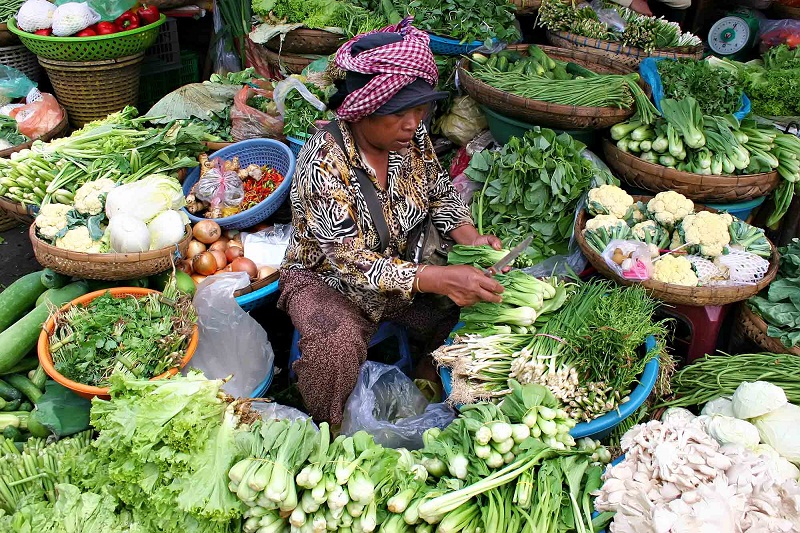
A recent study has uncovered high levels of pesticide residues in cabbage and okra sold on Ghanaian markets. In response, the Centre for Indigenous Knowledge and Organisational Development (CIKOD) is urging the swift adoption of agro‑ecological farming practices. The environmental advocacy group stressed that the findings should serve as a wake‑up call for government, farmers, and consumers to promote safer food systems and reduce reliance on synthetic agrochemicals.
Conducted in partnership with the Ghana Standards Authority, the study analysed 12 samples of cabbage and okra—two of the country’s most widely consumed vegetables. Results revealed that eight of the 12 samples, representing over 66 percent, exceeded acceptable pesticide residue limits. Notably, all six cabbage samples tested were non‑compliant.
Explaining the choice of crops, CIKOD’s Director of Programmes, Wilberforce Laate, said cabbage and okra were selected because of their popularity. “We chose these vegetables because they are widely consumed. Okra is eaten across the country, while cabbage has become a staple in salads and other meals. We wanted scientific evidence to confirm what many people had suspected,” he noted.
Health concerns
Mr. Laate expressed concern that ongoing exposure to pesticide residues could lead to serious long-term public health issues if immediate interventions are not taken. “There will come a time when the impact will be truly damaging because we are consuming these chemicals. That is why we need to halt this practice and promote safer agricultural methods,” he stated. He encouraged consumers, whenever possible, to grow their own vegetables for household use by utilising containers, buckets, and backyard gardens.
“We can return to the spirit of Operation Feed Yourself. You don’t necessarily need large plots of land; you can grow vegetables in buckets, containers, and small spaces for your own consumption,” Mr. Laate added. He also encouraged farmers to adopt biological pesticides and natural alternatives such as neem-based products instead of synthetic chemicals.
Mr Laate, however, acknowledged that farmers faced several challenges that contributed to the excessive use of synthetic pesticides. He said issues such as economic pressure, land tenure insecurity and the need for quick financial returns often compelled farmers to rely on chemical inputs. “I think we are not told enough about the challenges making farmers resort to these chemicals. Issues of quick money, land tenure and several other factors push farmers to use interventions that promise faster results,” he explained. He blamed the shortage of agricultural extension officers for the misuse and overuse of pesticides.
Agroecology as an alternative
Speaking on the importance of Agroecology, the Executive Director of Peasant Farmers Association, Bismark Owusu Nortey, described agroecology as a sustainable, nature-based farming system that reduces reliance on harmful chemicals while improving soil health, biodiversity and food quality. He explained that agroecology encouraged practices such as mulching, cover cropping, composting, agroforestry, crop-livestock integration and the use of indigenous farming knowledge.
“It is a farming practice that has been utilized for generations. It relies on materials that are readily available within farming communities to enhance production, rather than depending on imported chemical inputs,” Mr. Nortey explained. He noted that instead of burning crop residues after harvest, farmers could return them to the soil as mulch to conserve moisture and improve fertility. Additionally, livestock waste could be repurposed as organic manure. He emphasised that agroecology promotes the cultivation of indigenous crop varieties that are well adapted to local ecological conditions.
Commercial farming
Mr Nortey dismissed suggestions that agroecology was only suitable for smallholder farmers. He said modern conservation machinery, specialised equipment and drone technology were increasingly supporting large-scale agro-ecological production. Mr Nortey disclosed that the Peasant Farmers Association had begun working with the Ministry of Food and Agriculture to support the development of a national agro ecology policy aimed at promoting safe agricultural practices and strengthening food safety.
Source: Felicia Kwarteng

