


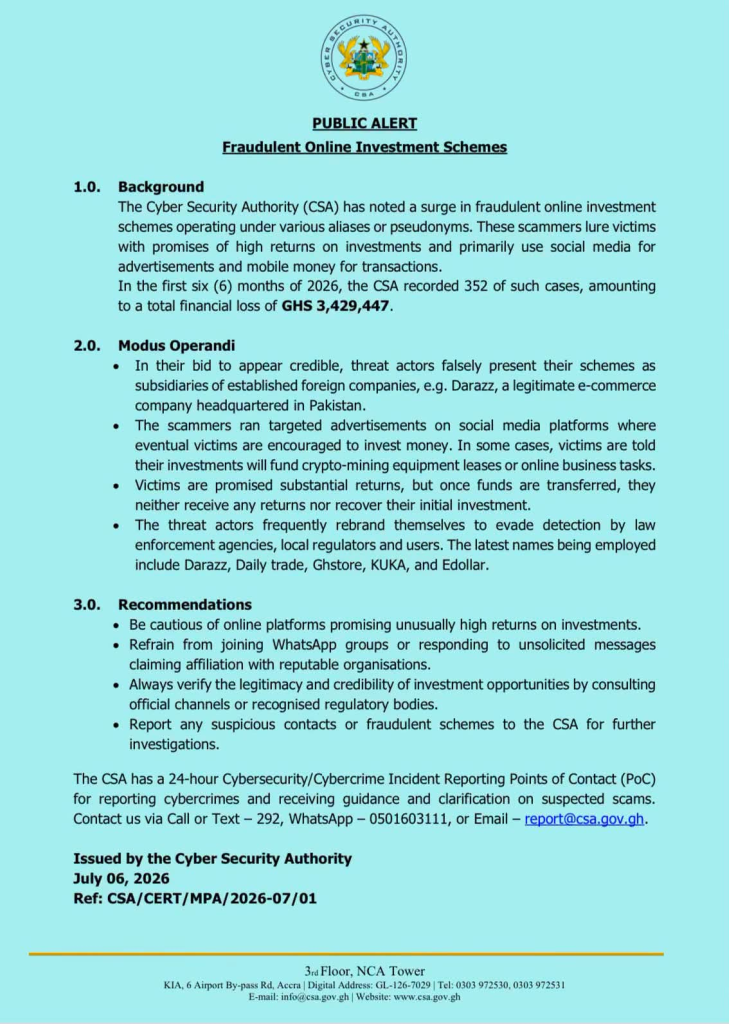
The Cyber Security Authority (CSA) has issued a public alert over a surge in online investment scams, disclosing that victims lost more than GH¢3.4 million in the first half of 2026. Between January and June, 352 cases of investment fraud were recorded, amounting to GH¢3,429,447 in losses.
According to the CSA, fraudsters operate under multiple aliases, enticing unsuspecting investors with promises of unusually high returns. These schemes are largely promoted through social media, with transactions conducted via mobile money. To gain credibility, scammers often pose as affiliates of established foreign companies—such as Darazz, a legitimate Pakistan‑based e‑commerce firm whose identity has been misused.
Victims are typically persuaded to invest in ventures such as crypto‑mining equipment leasing or online business tasks, with assurances of substantial profits. However, once funds are transferred, investors neither receive the promised returns nor recover their capital.
The CSA noted that the operators frequently change their identities to evade law enforcement and regulatory scrutiny. Among the names currently associated with the fraudulent schemes are Darazz, Daily Trade, Ghstore, KUKA, and Edollar.
The Authority urged the public to exercise caution when approached with investment opportunities promising unusually high returns. It also advised individuals to avoid joining unsolicited WhatsApp groups or responding to messages claiming affiliation with reputable organisations.
Prospective investors were encouraged to verify the legitimacy of investment opportunities through official channels or recognised regulatory bodies before committing funds.
The CSA further called on the public to report suspected fraudulent investment schemes to the Authority to support investigations and help curb the growing cybercrime threat.
The public alert, issued on July 6, 2026, underscores the increasing financial risks posed by online investment fraud and reinforces the need for greater vigilance as digital financial transactions continue to expand in Ghana.
Source: Daniel Oduro-Mensah

