

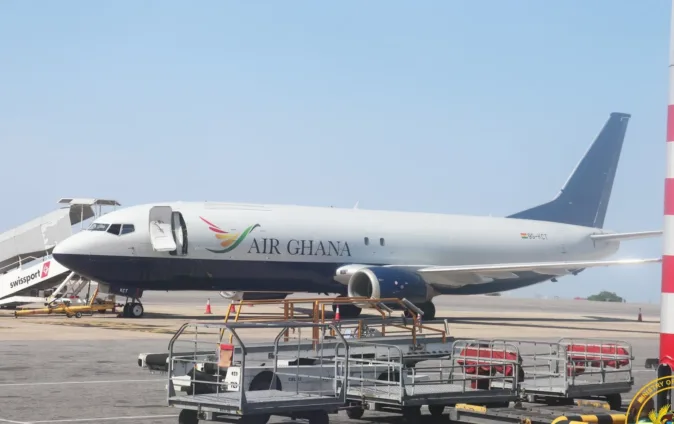
The Minister for Transport, Joseph Bukari Nikpe, has firmly dismissed rumours surrounding a viral aircraft branded as Air Ghana Cargo, clarifying that the plane is privately owned and bears no link to government operations. Appearing before the Public Accounts Committee (PAC) on Wednesday, May 20, 2026, the Minister emphasised that the aircraft is not part of state aviation activities, stressing instead that it represents an independent, private‑sector initiative.
The Air Ghana Contradiction
The clarification came in response to a direct question from the Committee’s Deputy Ranking Member, Davis Opoku Ansah, who sought official confirmation regarding widely circulated photographs of the cargo airline. The images had sparked intense public speculation over whether the state had discreetly acquired a new asset or expanded its transport operations. In his reply, Mr. Nikpe stressed that the aircraft is exclusively linked to Air Ghana, an independent cargo transport company owned and financed by private individuals. He underscored that the government holds no equity stake or operational authority in the company’s logistics.
Echoes of Ghana Airways’ Failures
During the parliamentary vetting session, the conversation naturally drifted toward the government’s ongoing plans to re-establish a national flyer. The Ranking Member of the PAC, Mr Samuel Atta Mills, reflected on his past experiences as a frequent traveller on the defunct Ghana Airways, raising critical concerns about the chronic delays and scheduling collapses that ultimately doomed the former national carrier.
Mr. Atta Mills observed that the former national airline’s chronic delays consistently discouraged passengers, particularly business travellers relying on time‑sensitive connections at international hubs. Confronted with these past shortcomings, the Transport Minister acknowledged that poor time management had gravely undermined the country’s reputation, admitting that the state had drawn hard lessons from the collapse of earlier aviation ventures.
“This is not a commendable record, and there are lessons we have learned as a people. That is why I appreciate the committee’s opportunity to respond to the issues raised by the special audit. We do not intend to hold a shareholding position that would impose dictatorial control over the services of the airline we plan to re‑establish,” Mr. Nikpe stated candidly.
A Minority-Stake Blueprint
To prevent a repeat of the political interference, bloated payrolls, and operational indiscipline that characterised Ghana Airways, the Minister revealed a structural shift in the state’s upcoming aviation strategy. He assured the parliamentary watchdog that the new home-based carrier would be heavily insulated from state dictation, with the government intentionally limiting its financial and administrative footprint.
“We only hold a small share, and then it will be a private-sector-led activity. It is not good that I have my scheduled travels and arrive at a point, and then you would delay the flight for me. There are lessons we have learnt that we will improve upon,” the Minister added.
Mr Nikpe concluded his testimony by assuring the committee that the Ministry of Transport is actively collaborating with international aviation stakeholders, regulators, and private financiers to entrench strict efficiency models, maximise turnaround times, and enforce rigid time management protocols within Ghana’s airspace moving forward.
Source: James Avedzi

