

Authorities are treating the hantavirus outbreak aboard a cruise ship carrying international passengers with the utmost seriousness. The vessel, which departed Argentina a month ago, has already recorded three fatalities—either on board or shortly after travel—and three additional individuals have been evacuated for medical care.
A large-scale operation is now underway to trace passengers who may have been exposed and have since flown home to countries including the UK, South Africa, the Netherlands, the United States, and Switzerland. While health experts emphasise that the overall risk to the wider public remains low, the incident raises pressing questions about how concerned we should be.
Contact-tracing a priority
The contact-tracing work has been “quite a mammoth effort”, Prof Robin May, chief scientific officer at the UK Health Security Agency (UKHSA) told BBC Breakfast, and one “we will continue to do… for some time”. In an update on Thursday, operator Oceanwide Expeditions said 30 passengers, including seven Britons, had disembarked when the ship docked at St Helena on 24 April. The company said it had contacted all of those who had already disembarked.
The UKHSA said two Britons who had left the ship at St Helena had contacted health officials when they heard about the cases after flying home from Johannesburg and are now voluntarily self-isolating in the UK. They do not have symptoms. In the US, health officials in Georgia and Arizona have confirmed to the BBC that they are monitoring three passengers who had returned to the US after disembarking. None currently have symptoms.
Experts have confirmed that human-to-human transmission is possible with the specific Andes strain detected. However, the World Health Organization (WHO) has emphasised that the global risk remains low, noting that hantavirus does not spread as readily as Covid-19 or influenza.
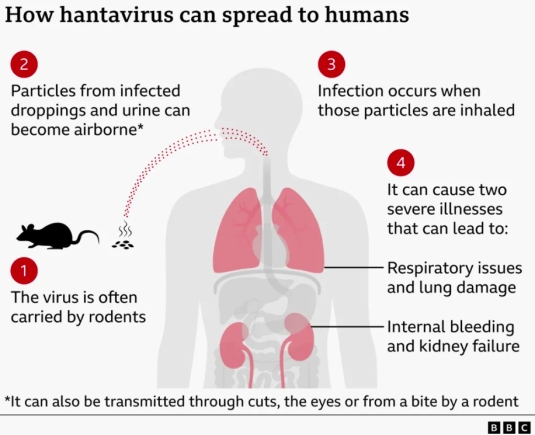
In its latest update, WHO reported eight cases linked to the ship—three confirmed and five suspected. The source of the outbreak has not yet been determined. Hantavirus is typically transmitted from rodents, with infection occurring when people inhale air contaminated by particles from rodent urine, droppings, or saliva.
Given that the cruise itinerary included remote wildlife areas, officials suggest that a passenger may have contracted the virus during those excursions or prior to boarding the vessel. Health experts believe that some of the infections on board MV Hondius may have passed between people who were in very close contact.
Even luxury cruise ships have relatively cramped or restricted living conditions, with people sharing cabins and dining areas – places where infections could spread.
The Andes strain of the virus has been confirmed in two of the ship’s passengers, according to South Africa’s health minister, and experts have observed the strain spreading between human patients in previous outbreaks, through very close contact. Unlike diseases such as measles, which are highly contagious and spread easily, the Andes strain of hantavirus is not that infectious.
People can catch it from someone that they spend prolonged time with in close physical proximity. The three deaths include a Dutch woman who left the MV Hondius when it stopped at the island of St Helena on 24 April. She had been sharing a cabin with her husband who previously died on board on 11 April, but is not a confirmed case of hantavirus. Hantavirus is not spread in the outside world through everyday social contact like walking in public spaces, shops, workplaces, or schools, the UKHSA says.
Symptoms usually appear between two to four weeks after being exposed to the virus, but can occur more than a month later. People ill with the Andes strain can have symptoms similar to flu – a fever, fatigue, muscle aches. They may also get shortness of breath, stomach pain, nausea and vomiting or diarrhoea.
There is no specific treatment, but early medical support in the hospital can improve survival. Treatment is for the symptoms displayed. Any British passengers returning from the cruise ship will be asked to self-isolate in the UK for 45 days, the UKHSA says. For the broader public, not directly involved in this cruise ship, “the risk here is really negligible, Prof May adds.
Some 19 British nationals were listed as passengers on the MV Hondius, which was sailing from Argentina to Cape Verde, with four British crew members. The UKHSA said officials were working to coordinate the arrival of British nationals to the UK from MV Hondius.
Dr Meera Chand, deputy director for epidemic and emerging infections at UKHSA, said: “It’s important to reassure people that the risk to the general public remains very low. “We are contact tracing anyone who may have been in contact with the ship or the hantavirus cases to limit the risk of onward transmission.”
The MV Hondius is now sailing towards Spain’s Canary Islands after being anchored for three days near Cape Verde, an archipelago nation off the West African coast. The plan is for the remaining passengers and crew to fly to their home countries. Oceanwide Expeditions said on Thursday that none of the people still on board were displaying symptoms and local health authorities have visited the vessel and assessed the situation.
Passengers have been isolating on board and the ship has been deep-cleaned by professionals ahead of the planned evacuation.
Source: bbc.com

