

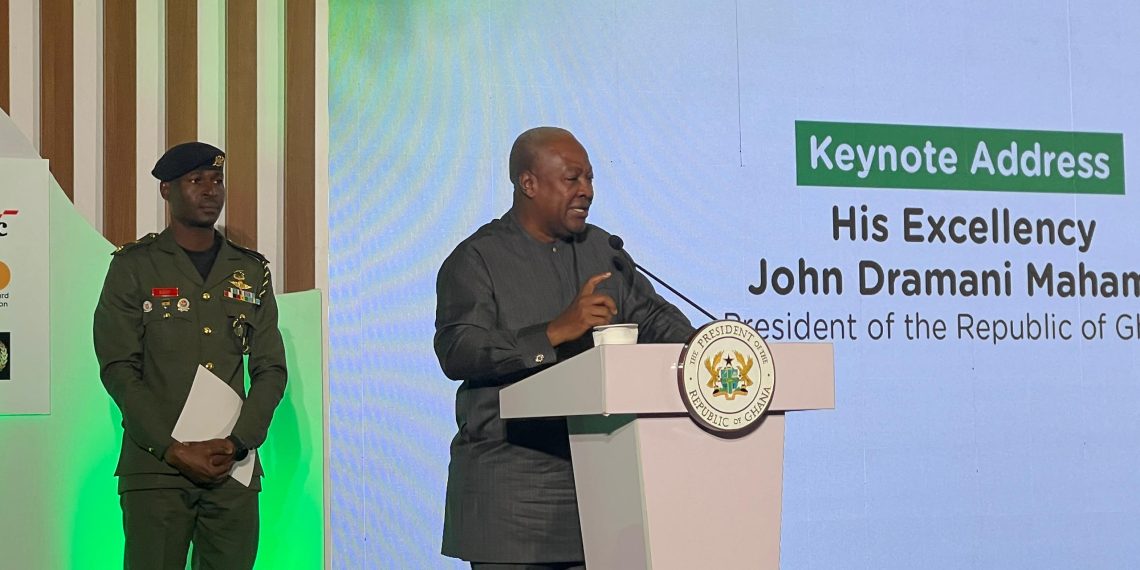
President John Dramani Mahama has announced the establishment of 11 new Farmer Service Centres as part of a nationwide initiative aimed at modernising agriculture and improving access for smallholder farmers. The president emphasised that the focus on mechanisation is part of a broader strategy to strengthen agribusiness, boost productivity, and support Ghana’s vision of a 24-hour economy through targeted public investment and industrial policy.
Speaking at the National Agribusiness Dialogue on Monday, July 28, 2025, under the theme “Resetting Agribusiness for Inclusive and Sustainable Industrial Growth,” President Mahama revealed that the Ministry of Finance has approved funding for the first phase of the rollout under the government’s Big Push agenda. “As part of the Big Push, the Finance Minister has approved funds to establish 11 out of 50 Farmer Service Centres to be located in farming zones across the country,” he stated.
These centres will house tractors and other equipment to provide mechanisation services directly to farmers within their catchment areas. “These tractors and equipment will not be sold to farmers. They will be stationed at strategic Farmer Service Centres to provide mechanisation support. What farmers really need is not to own tractors and combine harvesters, but rather access to the services they provide,” President Mahama explained.
Farmers will be required to register at their nearest centre and will be able to request services during the farming season without the burden of owning and maintaining expensive machinery. Agencies with the technical capacity to maintain the equipment will be engaged to operate the centres and ensure service delivery.
In addition to the mechanisation initiative, President Mahama also announced plans to promote Made-in-Ghana products through public procurement.
“The government is going to give priority to products manufactured in Ghana. As I speak, the 24-hour economy secretariat is compiling a comprehensive list of Ghanaian-made goods, including agro-processed products. Since the government is the biggest spender in the economy, these products will be prioritised in procurement,” he added.
By: William Narh

