

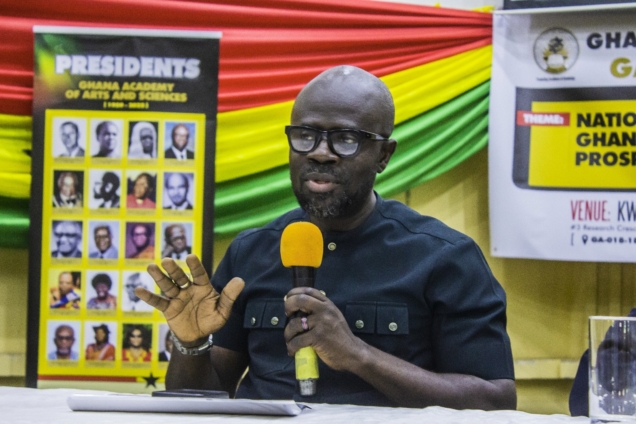
The Dean of the Law School at the University of Professional Studies, Accra (UPSA), Professor Ernest Kofi Abotsi, emphasized the need to address the public’s lack of trust in the Electoral Commission (EC) and its operations. He proposed that in the future, the appointment process for the chairs and other members of the Commission should be more inclusive, with broader consultations, to ensure that the appointments align with the preferences of the general public.
He made the call at the annual public forum of the Ghana Academy of Arts and Sciences, in Accra, on Monday, on the theme: “National Elections in Ghana: Issues and Prospects”. Prof Abotsi, who was speaking on the topic ‘Policy and Institutional Framework of National Elections in Ghana’, said the EC was constitutionally structured and established to deploy the electoral agenda of Ghana, adding that it was tasked with the mandate of supervising and administering the elections.
Article 45 of the Constitution mandates the Commission to, among other things, compile an electoral register, demarcate electoral boundaries for both national and local elections, educate the Ghanaian people on electoral processes and its purposes and undertake programmes for the expansion of the registration processes. These functions, Prof Abotsi said, made the EC the sole body of elections in Ghana and justified its elevation above others in matters dealing with electoral governance.
Again, he said that also explained why the Commission was constitutionally set up as an independent body, detaching it from the main political branches and actors of the state. However, he noted that the work of the Commission, over the years, had been the subject of deep contestations, especially by the two leading political parties – the National Democratic Congress and the New Patriotic Party.
“Ironically to either party, the EC is only good when the party is in power in which case they see nothing wrong with its activities or moves. To the other party in opposition, the EC is to be looked on with troubling suspicions and its decisions grilled with scepticism,” he said.
Prof Abotsi said such mistrust was concerning, attributing the scepticism and suspicions around the activities of the EC to the current mode of appointment of the Commissioner and other members of the Commission by a sitting president.
He indicated that the current status quo where the Commissioner was appointed by the sitting President who may himself be a candidate in the next election remained problematic. He noted that the situation if not checked could lead to a phenomenon in which governments may want to come in and inevitably leave with their own appointed electoral commissioner.
The trend is “disturbing because even if this situation is deemed merely perceived and not actual, the fact that the parties view the trend as real implies that they are likely to witness retaliatory responses when they take turns of power, leading to a complete destruction of the functional autonomy of the EC,” he stressed. He said it was imperative, therefore, that immediate steps were taken to deepen trust and confidence in the appointment process of the EC Commissioner, adding that one way to do that was to deepen and broaden the consultative aspect of the appointment process.
“I will suggest that in any future appointment of the Commissioner, sitting presidents should do well to actively consult opposition parties and engage in back-channelling with key stakeholders in the process,” he said. He added, “Recent controversies surrounding the use of the Ghana Card in voting, voter registrations and re-registrations, etc reflect that trust deficit and the challenge unfolding needs to be cured.”
The Head of the Department of Political Science, University of Ghana, Prof Alidu Seidu, also speaking at the event, stressed the need for the Commission to put measures in place to restore public confidence in its operations. He also urged that the powers of the Inter-Party Advisory Committee (IPAC) be strengthened to make decisions of the Committee binding on all parties, including the EC. He spoke on the topic: “Contribution of Political Parties to National Elections for Development: An Assessment”.
Source: GNA

