

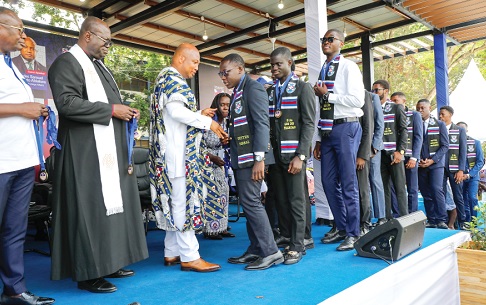
The Moderator of the General Assembly of the Presbyterian Church of Ghana, Rt. Rev. Dr. Abraham Nana Opare Kwakye has urged Ghanaians to protect the long-standing harmony in mission schools by promoting mutual respect among different religious groups and the proprietors of these institutions. He emphasised that while it is essential to respect the rights of individuals of various faiths, those who choose to receive their education in mission schools must also honour the rights and identities of the schools’ owners.
“Individuals of other faiths who attend mission schools have acknowledged that these institutions were established to uphold specific values. Efforts by a small number of people to disrupt this balance could jeopardise national unity if not addressed carefully. It is crucial for us to respect the rights of individuals from other religions.
However, it is equally important for those from different faiths who enrol in mission schools to respect the rights of the mission school owners,” Rt. Rev. Opare Kwakye stated during the 87th Speech and Prize-Giving Day of the Presbyterian Boys’ Secondary School (PRESEC) in Accra last Saturday. The moderator’s comment comes in the wake of recent controversy over accepting divergent religious practices on the premises of local educational institutions, particularly at the second cycle level, with an escalated version currently in court.
Ablakwa’s thoughts
The Minister of Foreign Affairs, Samuel Okudzeto Ablakwa, made a compelling argument for the importance of maintaining religious tolerance in schools. He described the country’s secondary school system as a vital component of nation-building. According to him, generations of Ghanaians have learned to coexist peacefully because secondary schools expose students to diverse backgrounds, cultures, and beliefs. He stated, “Our secondary school structure has been the most effective antidote to discrimination and prejudice. It is in secondary schools that we learn that no one from another part of Ghana is a threat and that diversity enriches us.”
The minister, who is a former student of PRESEC, questioned why a country celebrated globally for its religious tolerance is now facing new tensions. He referred to the National Chief Imam’s notable presence in churches and shared his own experience of hosting the Chief Imam in his home to highlight Ghana’s unique interfaith harmony.
He urged that the country’s focus should not be on strict doctrines or outward expressions of religiosity, but on the common humanity and love for one another. Mr Ablakwa said the more significant national concern should be about the values the country’s education system was producing.
He asked: “Why is our educational system producing graduates who create thousands of ghost names to steal from the state? Why are we producing graduates who destroy our environment and harm public health just for greed?” The minister emphasised the need for an educational philosophy that built ethical leadership, critical thinking, accountability and discipline.
Event
This year’s celebration, held on the theme: “Celebrating our heritage: Shaping future leaders through discipline and academic excellence”, brought together past students from several year groups, parents, government officials and clergy of the Presbyterian Church. Recognition was given to 47 former students who scored straight 8As in the 2024 West African Senior School Certificate Examination (WASSCE).
Mr Okudzeto Ablakwa presented each of the 47 high achievers with brand-new laptops to support their tertiary education and future academic journeys. In addition, several students who excelled in various subjects, disciplines and sports received awards for their exceptional performances over the academic year. The Headmaster of the school, David Odjidja, highlighted the school’s impressive academic outcomes.
He revealed that out of the 2024 WASSCE cohort, 47 students scored 8As, 106 had 7As, 117 obtained 6As, 270 students recorded aggregate 6, and almost 800 candidates achieved single-digit aggregates. He further mentioned that the school’s performance in the core subjects remained exceptionally strong.
Out of 1,933 candidates, 1,686, representing 87.2 per cent, scored A1–B3 in Social Studies, 1,685 obtained A1–B3 in English Language, 1,548, representing 80.1 per cent, recorded A1–B3 in Core Mathematics, and 1,632, representing 84.5 per cent, achieved A1–B3 in Integrated Science.
Challenges
Despite all the achievements, the headmaster outlined significant challenges confronting the school, driven largely by rising enrolment and the continuing double-track system. He said the school faced major deficits in classroom furniture, dormitory beds, library seating, dining hall furniture and general assembly space.
He disclosed that although the school had six science laboratory spaces, three of them provided by the church and the other three by the government, none of them had been equipped, and, therefore, remained locked.
To support the government’s plan to transition all double-track schools to single-track by the 2027/2028 academic year, Mr Odjidja said the school urgently required a 48-unit classroom block with furniture, 6,000-capacity dormitory blocks, 15 additional science laboratories and six computer laboratories. He appealed to the government, old students, the church and other stakeholders to assist in helping the school transition as soon as possible.
Source: Joshua Bediako Koomson

