

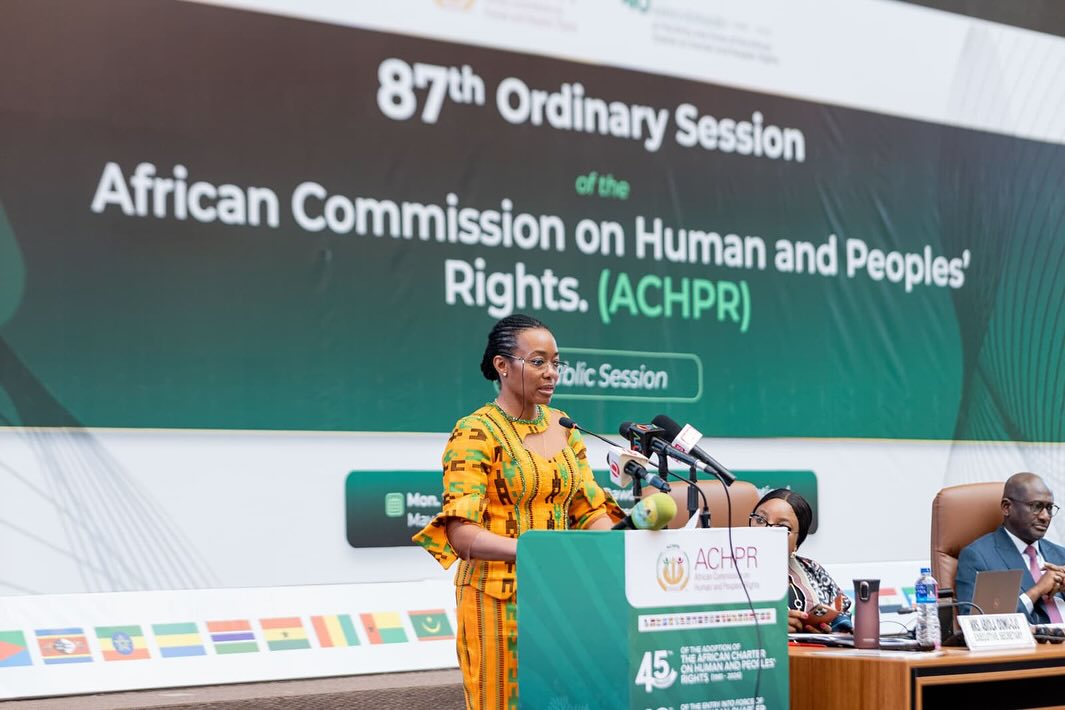
At the opening of the 87th Ordinary Session of the African Commission on Human and Peoples’ Rights in Banjul, the Member of Parliament for Klottey Korle, Dr. Zanetor Agyeman-Rawlings, underscored the need to recognise digital rights as fundamental human rights. Speaking in her capacity as Second Vice President of the Pan African Parliament on behalf of its President, Fateh Boutbig, she called for stronger human rights protections, democratic governance, and peacebuilding efforts across the continent.
Dr. Agyeman-Rawlings stressed that Africa must urgently establish legal and policy frameworks to safeguard citizens as artificial intelligence and digitalisation reshape societies. “In this new era of artificial intelligence and rapid digitalisation, there is an urgent need to recognise digital rights as human rights and to establish coherent legal and policy frameworks capable of protecting citizens in an increasingly digital world,” she said.
She further urged African Union member states to ratify the Malabo Convention, noting that it would strengthen Africa’s response to cybersecurity threats, protect citizens online, and advance digital sovereignty.
Dr Agyeman-Rawlings further stressed the need for member states to ratify and domesticate model laws developed by the Pan-African Parliament to improve governance systems and harmonise legislation across the continent. She said legal frameworks across Africa must remain responsive to the changing needs of citizens.
The Ghanaian lawmaker also highlighted the role women continue to play in peacebuilding, mediation and conflict prevention across Africa. “Women continue to serve as first responders, community stabilisers and bridge builders in times of crisis,” she said. Dr Agyeman-Rawlings warned that lasting peace and security on the continent could not depend solely on military interventions.
“Sustainable peace and security cannot be achieved through military responses alone,” she said. “We must invest in strong institutions, constitutionalism, civic participation, inclusive governance and the political will to ensure that citizens feel seen, heard and represented.” She said Africa’s future depended on the continent’s ability to build societies that are secure, inclusive and rights-based.
“Africa’s future depends on our ability to build societies that are secure, inclusive, rights-based and driven by the collective aspirations of our people,” she added.
Source: Edward Acquah

