
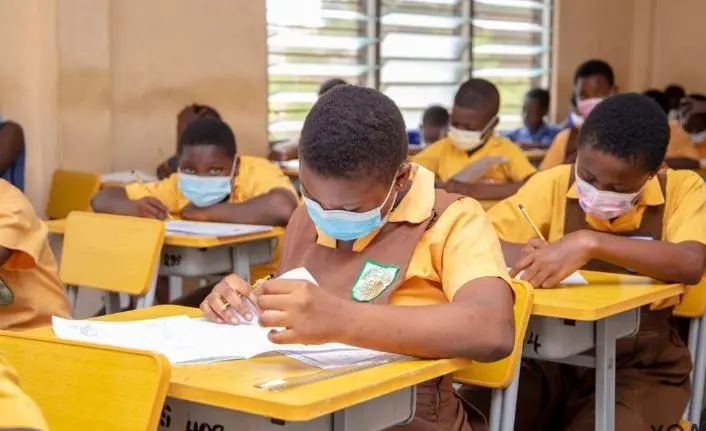
Former Public Relations Officer of the Ministry of Education, Kwasi Kwarteng, has called on the government to strike a balance between maintaining educational standards and ensuring access, arguing that students who fail either English Language or Mathematics in the Basic Education Certificate Examination (BECE) should not be automatically denied admission to senior high school.
His comments come amid controversy surrounding the 2026 Computerised School Selection and Placement System (CSSPS), following the initial exclusion of about 55,000 candidates from placement after they failed to meet the English and Mathematics requirement. The government has since opened the self-placement system to candidates who obtained Grade 9 in either English Language or Mathematics, allowing them an alternative opportunity to secure admission to schools with available vacancies.
Speaking on the Asaase Breakfast Show on Tuesday, September 8, Kwarteng acknowledged the importance of maintaining academic standards but stressed that such standards should not prevent young people from continuing their education.
“Honestly, again, in good conscience, I do not believe that standards and, of course, quality of education should be jettisoned at the altar of access,” he said. “But it is also important to understand that education works on three key variables: access, quality and relevance.”
He said meaningful educational development required a balance between those three factors, rather than an exclusive focus on examination performance. “It can’t be all about quality. It can’t also all be about access. But it has to be a marriage between access and quality,” he said. Mr Kwarteng argued that students who struggle in one of the two core subjects could instead be admitted and supported through remedial or intervention programmes.
He said that was the approach used under the previous placement policy, where students who passed either English or Mathematics could proceed to senior high school while receiving additional support to improve their performance. “Instead of creating barriers to cut or reduce access, what we rather did was that we would rather provide interventions that would help or support the students to attain quality,” he said.
He said such interventions could include additional classes designed to help students catch up with their peers. Kwarteng questioned the effectiveness of excluding students from public senior high schools when many of them could subsequently enrol in private institutions if their families could afford the fees.
“What then becomes the whole essence of denying them access to senior high schools because ultimately a lot of them also have to go and pay for private education?” he asked. “It is only those who cannot pay who are left behind.” He also warned that the consequences of denying students an opportunity to continue their education could extend beyond the immediate placement exercise. “If we don’t provide any psychological support for them, if we don’t provide any pathway for them, what else is that?” he asked.
“Many of them have seen their dreams shattered,” Kwarteng lamented, stressing that the education system must pay closer attention to students from rural and peri‑urban areas, where access to resources and opportunities is often limited compared to more affluent communities. He argued that weaker BECE performance can sometimes reflect systemic inequalities rather than a lack of ability. “We knew from the beginning that the foundation was weak. It was a systemic failure, a government policy failure,” he said.
Kwarteng maintained that education policy should focus on identifying and supporting struggling learners instead of excluding them. “Quality is important, but government can pursue quality through more creative approaches,” he added.
His remarks come as the government faces mounting demand in the 2026 placement exercise. While more than 527,000 candidates have secured placements, 76,635 qualified students were initially left unplaced, largely due to intense competition for Category A schools.

